

posted 17th August 2026
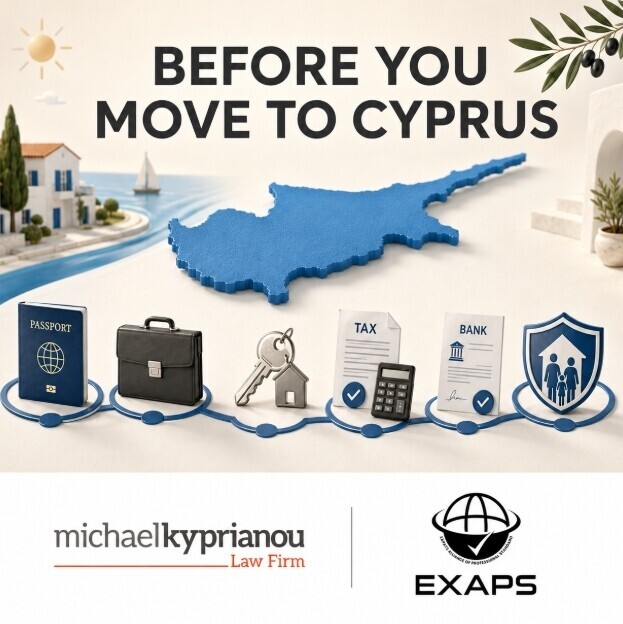
Moving to Cyprus involves more than finding a home and booking a flight. Residence, work, tax, property, banking and family protection are connected - but they are not the same thing. Getting them in the right order can make the move considerably smoother. And using legal professionals like Michael Kyprianou Law Firm can help you get things done correctly.
Cyprus attracts people for many different reasons. Some are moving for work. Others are retiring, setting up a business, joining family, working remotely or simply looking for a better pace of life in the sun.
Once the idea of moving starts to feel real, the practical questions tend to take over. Which part of Cyprus should we choose? Should we rent or buy? Which school is right for the children? How soon can we open a bank account? Those are important questions, but they are not always the first ones that need to be answered.
Before paying a property reservation fee, resigning from a job or moving a large sum of money, an individual or family should understand the legal structure of the move. That does not mean turning relocation into a law degree. It simply means considering the right issues in the right order, while there is still time to make good decisions.
The most important point to understand is that owning a home, holding a residence document, having permission to work and being tax resident are four different things. One does not automatically create the others. A successful move begins by joining those pieces together before any major commitment is made.
Begin With The People, Not The Property
It is natural to begin a move by looking at homes, but the correct legal route is determined first by the people who are moving.
Nationality is an obvious starting point, including any second nationality held by a member of the family, but it is not the only consideration. Passport validity, marital or civil partnership status, financial dependency and the ages of any children can all affect the available options. So can each person's plans once they arrive.
Someone who intends to work for a Cyprus employer may require a different solution from a pensioner, student, business owner or person working remotely for an overseas company.
The source of the family's income matters too. If children are moving with only one parent, any questions about parental responsibility, consent from a former partner or an existing court order should be addressed well before departure.
This may sound like basic preparation, but a single household can contain several different legal positions. An EU citizen may be moving with a non-EU spouse. A British parent may have a child who holds an Irish passport. One spouse may be able to live in Cyprus through the other's status, but that does not necessarily mean that every family member has exactly the same rights. An older child may also cease to qualify as a dependant during the family's first few years on the island.
The family should therefore be assessed person by person, rather than everyone simply being placed under the nationality or circumstances of the main applicant.
This is particularly important for British nationals. Following Brexit, a British passport does not generally carry the free movement rights of an EU passport. Unless a person holds another relevant nationality or is protected by a specific arrangement, they will normally be treated as a third country national for Cyprus immigration purposes.
Choose The Residence Route Before Choosing The House
Once the position of each family member is understood, the next task is to identify the correct basis on which they will live in Cyprus. Ideally, this should happen before the family commits to a property purchase, a long lease or an irreversible moving date.
EU citizens have rights to move and reside under EU law, subject to the applicable conditions. In Cyprus, an EU citizen intending to remain for longer than three months must apply for a Registration Certificate, commonly called the MEU1, within four months of arrival. At the date of this article, the government fee is €20.
The evidence required will depend on the person's circumstances. Someone who is employed or self employed will not necessarily provide the same documentation as a pensioner, student or self sufficient person.
A non-EU family member accompanying an EU citizen will normally use a different residence card procedure, commonly known as the MEU2. After five years of continuous legal residence, EU citizens and qualifying family members may acquire a right of permanent residence, provided the relevant conditions have been met.
For non-EU citizens, there is no single, universal “Cyprus visa” that suits everyone. The appropriate route depends on what the person will actually be doing in Cyprus. Depending on the circumstances, the options may involve employment, family reunification, temporary visitor residence, study, remote working, business activities or permanent residence through qualifying investment. Each route has its own rules concerning income, accommodation, insurance, family members, work and renewal.
The distinction is important. A third country national holding a visitor's temporary residence permit is not permitted to carry out economic activity in Cyprus. By comparison, the Cyprus Digital Nomad Visa is a separate route for qualifying non-EU and non-EEA nationals who work remotely for an overseas employer or overseas clients. At the date of this article, the main applicant as a Digital Nomad must demonstrate stable net monthly income of at least €3,500 - with additional financial requirements where family members are included.
That figure should never be treated as a complete eligibility test. It simply illustrates why the precise route, rather than a general intention to “get residency”, matters.
Property ownership is another area in which assumptions can be costly. Buying a home in Cyprus does not, by itself, give someone the right to live or work there.
There is an expedited permanent residence route for qualifying third country investors, but it is a specific immigration programme rather than an automatic benefit attached to every property purchase. At the date of this article, the official route requires an investment of at least €300,000 (plus the prevailing VAT rate) and secure annual income of at least €50,000 for the main applicant. The income requirement currently increases by €15,000 for a spouse and €10,000 for each dependent minor child. Further conditions apply to matters such as the type of investment, source of funds, health insurance, criminal record evidence and continued maintenance of the investment.
Someone purchasing a €300,000 property should therefore never assume that the price alone satisfies the immigration rules. The property transaction and the residence application need to be considered together.
Make Sure The Right To Live In Cyprus Includes The Life You Intend To Lead
The right to reside is not always the right to work. This is one of the most important distinctions for working age adults and one of the easiest to overlook.
Before moving, each adult should understand whether the proposed immigration status permits work and, if so, what kind. The answer may differ depending on whether the person will work for a Cyprus employer, remain employed by an overseas business, provide services to foreign clients, run a company or join a family business. A spouse or partner may not automatically have the same working rights as the main applicant, and the arrangement may also create payroll, social insurance or employment obligations.
Being paid into a foreign bank account does not necessarily mean that the work is being performed abroad. If someone is sitting in Cyprus and carrying out their duties from Cyprus, immigration, employment, tax and social insurance questions may arise there, even if the employer, clients and bank account are all elsewhere.
Similarly, forming a Cyprus company does not automatically resolve an individual's immigration position. The company, the role being performed and the person's permission to carry out that role must fit together.
Visitor residence provides a useful example. It may be suitable for someone living from a pension or other qualifying overseas resources, but the official rules expressly prohibit economic activity. A person intending to work remotely should not assume that a visitor permit is “close enough” to the status they actually require. There could be other remedies to this, however we suggest that you contact a professional, like Michael Kyprianou Law Firm, to discuss these.
The safest approach is to describe the intended working arrangement fully and honestly before selecting a residence route. That conversation is much easier to have before the move than after employment has started.
Plan The Tax Position Before Fixing The Moving Date
Immigration residence and tax residence use different tests. A person can have permission to live in Cyprus without immediately becoming Cyprus tax resident. Equally, their pattern of travel and personal or financial connections may create tax consequences that played no part in the immigration application.
Cyprus currently has two principal day count routes for individual tax residence. Under the 183-day rule, a person who spends more than 183 days in Cyprus during a calendar year may be treated as Cyprus tax resident. The separate 60-day rule can apply where a person spends at least 60 days in Cyprus and satisfies several additional conditions. These include limits on the time spent in any other single country, specified business, employment or office holding ties with Cyprus and the maintenance of a permanent home in Cyprus.
Counting days is only the beginning. Another country may also consider the individual to be tax resident under its own domestic rules. Where both countries claim residence, an applicable double tax treaty may contain “tie-breaker” provisions. These can examine where the person has a permanent home, where their centre of vital interests lies, where they habitually live and, in some cases, their nationality.
Tax residence is also different from domicile. Cyprus non-domicile treatment can be valuable for some new residents because it affects Special Defence Contribution on certain categories of passive income. It is not a residence permit, however, and it certainly does not mean that all income becomes tax free.
This is why tax advice is most useful before the move rather than after it. The timing of relocation can affect salary and bonuses, dividends, investment disposals, pension withdrawals, the sale of a business or family home and rental income from property left behind. Business owners may also need to consider where a company is managed and controlled, while many movers will continue to have tax returns or other reporting duties in the country they are leaving.
Cyprus may offer an attractive tax framework, but the useful question is not simply, “How low is the tax?” It is, “Where will each type of income be taxed, from what date, and what must be reported in both countries?”
Let The Housing Decision Support The Wider Plan
There is nothing wrong with falling in love with a home in Cyprus. The difficulty begins when emotion is allowed to set the legal timetable.
For many families, renting first creates valuable breathing space. It gives them time to test an area, complete immigration formalities and understand their long term finances before purchasing.
For others, a property purchase may form part of a carefully planned residence or investment strategy. Neither approach is automatically right or wrong, but the housing decision should support the family's wider legal and financial plan.
Anyone renting should make sure that the landlord owns the property or has the authority to let it, and that the agreement clearly records the term, renewal arrangements, break rights and deposit provisions. Responsibility for utilities, communal charges, repairs, maintenance and insurance should also be understood. Families with pets should obtain clear permission, while anyone relying on the tenancy as evidence for a residence or tax application should make sure that it is suitable for that purpose. A casual holiday letting arrangement may not provide the certainty or documentation needed for a permanent relocation.
Buying requires a different level of due diligence. The buyer should use an independent lawyer who acts for them and carries out the appropriate checks before a reservation payment or contract becomes non-refundable. Depending on the property, those checks may cover ownership and title, mortgages or other encumbrances, planning and building permissions, access rights, communal obligations, VAT, transfer fees, alterations to the property and the seller's legal ability to transfer it.
Non-EU buyers may also require permission from the competent authority under Cyprus law before acquiring immovable property. That is a property law requirement and is separate from permission to reside in Cyprus.
Where a sale contract is used, the Cyprus Department of Lands and Surveys advises that it should be deposited promptly and no later than six months after signing. Depositing it brings the transaction within the protection of the Sale of Immovable Property (Specific Performance) Law and helps protect the purchaser if the seller fails to perform the agreement.
The property and immigration advisers should therefore understand what each side of the move is trying to achieve. A perfectly valid property purchase may still be unsuitable for a particular immigration route.
Prepare The Story Behind The Money
Opening a bank account or transferring a property deposit can take longer than expected when the documentary history of the money is incomplete.
Cyprus banks, lawyers and other regulated professionals are required to carry out customer due diligence. Depending on the circumstances and level of risk, they may need to understand both the source of funds (where the money for a particular transaction came from) and the source of wealth, meaning how the person accumulated their overall wealth.
These questions are not an accusation, nor are they unique to Cyprus. They form part of the anti-money laundering framework that regulated institutions are required to follow.
The easiest case to deal with is one supported by a clear file prepared in advance. A person using savings from employment may need bank statements, payslips or tax returns. Money from the sale of a home can usually be traced through the sale contract, completion statement and bank records. An inheritance might be supported by probate documents, while business or investment proceeds may require company accounts, dividend vouchers or sale statements.
Loans and family gifts should be properly documented, including evidence showing where the lender or donor obtained the funds.
Passing money through several accounts, accepting unexplained transfers or converting assets immediately before a transaction can make the trail more difficult to demonstrate.
Cryptocurrency proceeds may require a particularly clear history showing acquisition, ownership, trading activity, movement through exchanges and eventual conversion into conventional currency.
It is sensible to ask the receiving bank and the lawyer what they are likely to need before initiating a large transfer. Questions are far easier to answer while the original records remain accessible.
Assemble The Family's Documents Before Departure
Residence applications frequently depend on documents issued in another country, such as birth, marriage, civil partnership, divorce, adoption, custody or criminal record certificates.
An ordinary photocopy may not be enough. Depending on the country that issued the document and the purpose for which it will be used, it may need to be recent, certified, apostilled or diplomatically legalised. It may also require an official translation into Greek or English.
The position is simpler for certain public documents moving between EU Member States. EU Regulation 2016/1191 removes the apostille requirement for specified documents, including certain records relating to birth, marriage, parenthood and criminal history. A multilingual standard form can also reduce the need for translation in some cases.
Documents from many non-EU countries that participate in the Hague Apostille Convention will normally require an apostille. If the issuing country is not a party to the Convention, diplomatic legalisation may be needed instead. The exact requirements should always be checked before documents are ordered because validity periods and certification rules can vary between applications.
Names and dates should be checked carefully across every passport and certificate. Previous marriages or civil partnerships may require supporting evidence, and children travelling with only one parent may raise questions about parental responsibility or consent to relocate.
Particular care is also needed where a dependent child is approaching an age limit or a passport is likely to expire during the application process.
A small inconsistency that is relatively easy to correct at home can become an expensive and frustrating delay after arrival.
Do Not Leave Wills And Family Protection Until “Later”
Wills are often placed at the bottom of the moving list. They deserve to be considered much earlier, particularly where a family will own property in Cyprus, retain assets in another country or includes children from a previous relationship.
Moving country can affect which courts and laws become relevant to a person's estate. Under the EU Succession Regulation, the law of the country in which a person was habitually resident at death will usually govern the succession. A person can generally choose the law of their nationality instead, but that choice should be made expressly and clearly in a will or separate declaration.
An existing foreign will is not necessarily invalid simply because the person moves to Cyprus. It may, however, fail to deal with Cyprus assets efficiently or lack the most appropriate choice of law wording.
Creating a new Cyprus will without reviewing the foreign will can be equally risky if one document unintentionally revokes the other. A coordinated review should look at the whole picture. Property and bank accounts in Cyprus, assets and pensions held elsewhere, companies, trusts, intended beneficiaries and the people chosen to administer the estate.
Families with younger children should consider guardianship wishes, while marriage, divorce, a new child and children from earlier relationships can all change the outcome.
Advice may also be needed about forced heirship or reserved share rules and the practical process of administering an estate across more than one country.
Estate planning is not only for the wealthy. It is about making a difficult time more manageable for the people left behind.
Bring Every Part Of The Move Onto One Timetable
Once these issues have been considered, the move can be turned into a joined-up and realistic timetable.
The process usually begins by mapping the nationality, family circumstances, work plans and income of everyone moving. That allows the appropriate residence route and supporting evidence to be identified. The working rights of each adult can then be checked alongside any employer, company, payroll or social-insurance requirements.
The proposed moving date should be tested against the family's likely tax position in Cyprus and in the country they are leaving. With that picture in place, they can choose a rental or purchasing strategy that supports the residence plan rather than conflicts with it. Banking and source of funds records can be prepared at the same time as overseas certificates are obtained, legalised and translated. Wills, succession arrangements and protection for children or other dependants should also be reviewed before the final irreversible dates are fixed and substantial funds are transferred.
Not every family will need every stage, and several parts of the preparation can run alongside each other. The value lies in having one coordinated plan, rather than a collection of professionals working separately from different assumptions.
Before paying a reservation fee, signing a long lease or choosing a final moving date, the family should be confident that it understands the legal basis on which each person will live in Cyprus and which adults may work.
It should have a clear idea of when tax residence may begin, whether another country might continue to claim tax residence and whether the proposed home supports the immigration plan. It should also know that the ownership arrangements are suitable, the movement of funds can be explained, the necessary family documents are in order and its wills will operate sensibly across every relevant country.
When those questions have clear answers, the rest of the move becomes far more manageable.
One Move, One Coordinated Legal Plan
There is a lot to think about!
The purpose of early legal advice is not to make relocation feel complicated. It is to prevent avoidable complications from appearing later.
Michael Kyprianou Law Firm advises international individuals and families across immigration, immovable property, international tax planning and private client matters. That breadth is particularly valuable in a relocation because a decision in one area can change the answer in another.
The best time to seek advice is not after a residence application has been refused, a property deposit has been paid or a tax deadline has passed. It is while the family still has choices.
Cyprus can offer an exceptional place to live, work, retire or raise a family. A little planning at the beginning allows the legal arrangements to support that new life rather than interrupt it.
Don’t “wing it”. Win it.