


posted 26th May 2026
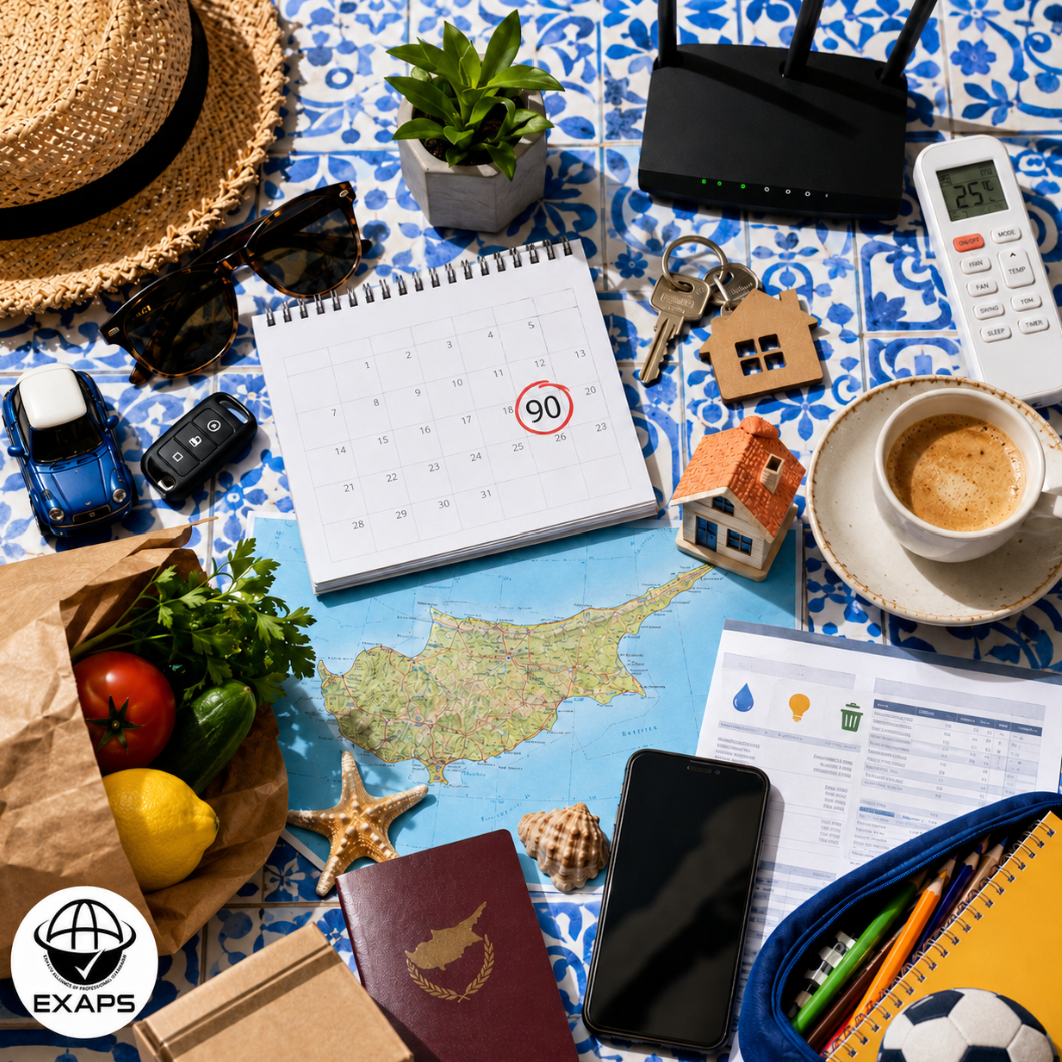
Moving to Cyprus is exciting. There is the sunshine, the sea, the food, the idea of a better pace of life, and the satisfying feeling that you have finally done something bold instead of just talking about it for years over a rainy cup of tea.
But once the suitcases are unpacked, the airport glow fades and everyone has stopped saying “it feels like we’re on holiday”, real life begins to arrive.
And real life, even in Cyprus, still involves paperwork, supermarket trips, school runs, bills, bank accounts, Wi-Fi problems, missing plug adapters and the sudden realisation that you have no idea where to buy a decent mop.
The first 90 days can be brilliant, emotional, chaotic and slightly sweaty. For many new arrivals, it is the period where the dream starts turning into normal life.
Here are some of the things people often wish they had known before landing.
The First Few Weeks Are Not the Real Version of Your New Life
The early days can feel like a strange mixture of holiday, house move and admin marathon.
You may still be eating out more than usual, driving around exploring, taking photos of sunsets and saying things like “can you believe we live here now?” every ten minutes. That is lovely. Enjoy it.
But it is also worth remembering that the first few weeks are not always a fair picture of normal life. You may be spending more money than you expected, still waiting for belongings to arrive, trying to arrange utilities, sorting paperwork, finding schools, registering for services and working out how everything functions.
It can feel unsettling, even when the move is the right decision.
This does not mean you have made a mistake. It usually means you are in the adjustment phase, where everything takes a little longer because everything is new.
Even buying bin bags can feel like a small expedition when you do not yet know which shop sells what.
Admin Has a Way of Finding You
Every country has its own rhythm when it comes to paperwork, and Cyprus is no different.
New arrivals may need to think about residency permissions, healthcare arrangements, tax position, school paperwork, bank accounts, driving documents, vehicle matters, insurance, rental contracts, utility accounts and various forms of identification or certification.
Some of it may be straightforward. Some of it may require patience. Some of it may involve being sent from one place to another and quietly wondering whether you have accidentally joined a treasure hunt.
The key lesson is to start early, keep copies of everything and never assume that one document is enough. It is often sensible to have passports, birth certificates, marriage certificates, rental agreements, proof of income, insurance documents, school records and other important papers easily accessible.
If something needs to be apostilled, certified or translated, it is usually better to know before you need it urgently.
Panic paperwork rarely brings out the best in anyone.
Your Budget May Behave Badly at First
Many people prepare a relocation budget and then discover that the first 90 days have other ideas.
There are always extra costs at the beginning. Deposits, furniture, temporary accommodation, rental cars, school supplies, medical insurance, home essentials, household bits, set-up fees, phone contracts, eating out before the kitchen is properly ready, and the endless small purchases that make a house function.
It is not always one dramatic bill. It is more like being nibbled by receipts.
- A fan here.
- A saucepan there.
- A pool net.
- A printer.
- A new shower curtain.
- Another adapter.
- A mystery item from a hardware shop that you are convinced will solve everything.
For the first few months, it is wise to have a buffer. Not a “maybe we will treat ourselves” buffer, but a proper “life is more expensive when you are setting it up from scratch” buffer.
Things usually settle down, but the early stage can feel financially noisier than expected.
The Area You Chose May Feel Different Once You Live There
Before moving, people often research areas heavily. They look at photos, watch videos, join groups, read posts, ask questions and mentally place themselves into a particular town or village.
That is useful, but nothing replaces actually living there.
An area that felt perfect on holiday may feel different when you need to do the school run, commute, shop, walk the dog, visit the doctor, find parking or get home after dark. A peaceful location may be beautiful but inconvenient. A busy area may be practical but noisier than expected. A coastal spot may be ideal in summer but quieter in winter.
The first 90 days are often when people start to understand what they really need.
You may discover that being closer to school matters more than being closer to the beach. You may find that a village lifestyle suits you perfectly. Or you may realise that you prefer somewhere with more year-round life, shops, restaurants and services.
This is one of the reasons renting before buying can be so helpful. It gives you time to test the reality before committing to the dream.
The Heat Changes How You Live
Cyprus heat is not just “nice weather”. In the warmer months, it changes routines. People go out earlier, slow down in the hottest part of the day, think carefully about pets, children, exercise, shopping and even where the car is parked.
New arrivals sometimes underestimate how much the heat affects daily life, especially if they are used to UK weather where summer often means carrying both sun cream and a raincoat just in case.
Air conditioning becomes important. Shade becomes valuable. Water bottles appear everywhere. Walking anywhere at the wrong time of day can suddenly feel like a personal challenge set by the sun.
It is not something to fear, but it is something to respect.
The people who adjust quickest are often the ones who stop trying to live exactly as they did before and start working with the local rhythm.
Children May Need Time, Even If They Seem Excited
For families, the move is not just about adults making a lifestyle decision. Children have their own version of the move.
They may be excited about the pool, the beach, the sunshine and the adventure. But they may also miss friends, grandparents, familiar routines, old bedrooms, clubs, teams, schools and the comfort of knowing exactly how everything works.
The first 90 days can involve emotional ups and downs. A child may seem fine one day and homesick the next. That is normal.
New schools, new accents, new friendship groups, new timetables and sometimes a new curriculum can take time. Parents should not panic if everything does not feel settled immediately.
A good routine helps. So does patience, reassurance and allowing children to talk honestly without feeling they have to be grateful every second because “we moved to a sunny island, remember?”
Sunny islands still have big feelings.
You Will Probably Need Help More Than You Expected
There is a strong temptation when moving abroad to try to do everything yourself.
Some of that is sensible. Research is important. Independence is good. Nobody wants to spend money unnecessarily. But there are moments when the right professional help can save time, stress and mistakes. This may involve legal advice, tax planning, immigration support, property guidance, valuations, schooling advice, insurance, removals, vehicle import support or healthcare arrangements.
The difficulty is knowing who to trust when you are new to the country.
That is one of the reasons EXAPS exists: to help people moving abroad find professional services more confidently and to make trust easier to identify in unfamiliar markets.
It is not about making the move complicated. It is about recognising that when you are building a new life, good guidance can be extremely valuable.
You May Miss Strange Things
People expect to miss family and friends. They may expect to miss certain places, routines or events.
What often catches people off guard is missing oddly specific things.
- A particular supermarket aisle.
- A local chippy.
- Your old gym.
- A familiar radio station.
- Knowing which road to take without thinking.
- A Sunday routine.
The exact biscuits you used to buy without any emotional attachment until you suddenly cannot find them. This is not a sign that the move is wrong. It is part of transition.
You are not just changing address. You are changing the background noise of your life. That takes a little while.
The good news is that new routines slowly replace old ones. One day, without noticing, you will know where to buy the good bread, which pharmacy is open late, which beach is best after school and which road to avoid when everyone else has had the same idea.
That is when Cyprus starts to feel less like somewhere you moved to and more like home.
Friendships Take Effort at First
Moving to a new country can be socially strange.
You may meet lots of people quickly, especially through schools, work, neighbours, online groups or local communities. But turning acquaintances into genuine friendships takes time.
It is worth making the effort early. Say yes to the coffee. Join the group. Go to the event. Speak to other parents. Ask questions. Be open.
At the same time, do not panic if you do not instantly find your people.
Not every friendly chat becomes a friendship. Not every group will be your group. That is fine.
The first 90 days are about planting seeds. Some grow quickly. Others take longer. A few are best left unwatered.
Normal Life Is the Goal
One of the strangest moments after moving to Cyprus is when the extraordinary becomes ordinary.
The first time you see the sea on a school run, it feels unreal. The first sunset from your terrace feels like a reward. The first warm evening outside in November feels slightly magical.
Then, slowly, it becomes your life.
You still have emails. You still have laundry. You still lose keys. Children still need shoes. The dog still needs walking. Someone still has to take the bins out.
That is not a disappointment. That is the point.
The goal is not to live permanently in holiday mode. The goal is to build a real, happy, sustainable life in a place that suits you better.
The first 90 days are the bridge between the dream and the routine.
Final Thought
The first 90 days in Cyprus can be exciting, confusing, expensive, sunny, emotional and unforgettable.
There will be moments when everything feels wonderful and moments when you wonder why something simple has taken three hours, two car journeys and a WhatsApp message to someone who knows a man. That is normal.
The best advice is to arrive prepared, stay flexible, ask questions, keep a budget buffer, give everyone time to adjust and avoid making huge decisions while still in the chaos stage.
Cyprus can be a fantastic place to build a new life, but settling properly takes more than unpacking boxes.
It takes patience, local knowledge, the right support and a willingness to laugh when things do not go exactly to plan.
Because in the first 90 days, they probably will not. And that is all part of the adventure.